How to Use Bacteriostatic Water for Peptides — Complete Reconstitution Guide
Last updated: April 22, 2026 · Reading time: 6 minutes · For research use only
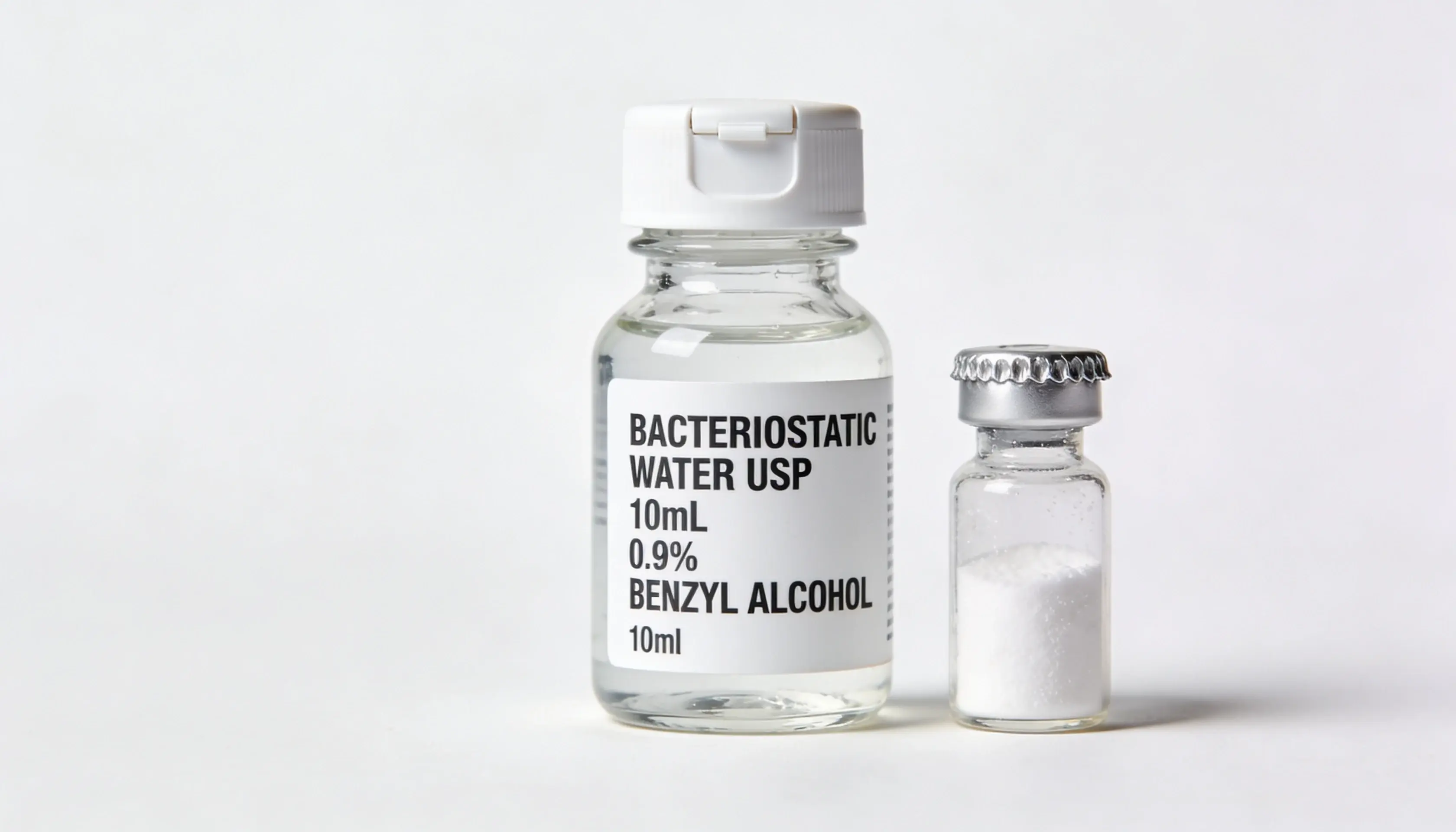
Bacteriostatic water is the single most common diluent used to reconstitute lyophilized peptides in research. If you are working with a freeze-dried peptide vial, chances are you need bacteriostatic water — and getting the dosing math, storage conditions, and handling technique right matters more than most people realize. This guide walks through all of it.
Quick summary:use USP-grade sterile water preserved with 0.9% benzyl alcohol; inject along the inside wall of the peptide vial (never straight onto the powder); swirl gently, don't shake; refrigerate between 2 and 8 degrees Celsius after opening; discard after 28 days.
What is bacteriostatic water?
Bacteriostatic water is sterile USP-grade water with 0.9% benzyl alcohol added as a bacteriostat. The benzyl alcohol inhibits bacterial growth, which is what allows a single 10 mL vial to be drawn from multiple times over a 28-day window without becoming contaminated. That multi-dose capability is the reason it has become the default diluent for peptide research.
Bacteriostatic water vs sterile water — what's the difference?
Plain sterile water (often labelled “Sterile Water for Injection, USP”) contains no preservative. It must be used once and discarded — the moment you break the seal, any remaining water is no longer considered sterile. Bacteriostatic water, thanks to the 0.9% benzyl alcohol, stays usable for 28 days. That is the only meaningful difference, but it is a big one for research workflows that involve small repeated withdrawals.
How to reconstitute a peptide — step by step
- Prepare the vials. Place both the peptide vial and the bacteriostatic water vial on a clean surface. Wipe both rubber stoppers with a 70% isopropyl alcohol swab and let them air-dry for 10 to 15 seconds.
- Draw the water. Using a sterile insulin or tuberculin syringe, draw the desired volume of bacteriostatic water from the 10 mL vial. The table below helps you pick the volume.
- Inject along the wall. Insert the needle into the peptide vial at a slight angle so the water runs down the inside wall of the glass. Do not aim the stream directly at the lyophilized powder — it can denature the peptide or create foam.
- Dissolve by swirling. Swirl the vial gently with a slow circular motion for 20 to 30 seconds. Never shake. Peptides are fragile and shear forces from shaking can break the molecule.
- Inspect. The solution should be clear and colorless. If you see particles, cloudiness, or discoloration, do not use it.
- Label and store. Write the reconstitution date on the vial with a marker. Store refrigerated between 2 and 8 degrees Celsius and use within 28 days.
Reconstitution math — how much bacteriostatic water to add
The formula is simple: final concentration (mg/mL) = peptide mass (mg) ÷ water volume (mL). The table below covers the most common starting points. Adjust the volume to suit the concentration your protocol calls for.
| Peptide mass | BacWater added | Final concentration | 250 mcg dose = |
|---|---|---|---|
| 2 mg | 1 mL | 2 mg/mL | 0.125 mL |
| 5 mg | 1 mL | 5 mg/mL | 0.05 mL |
| 5 mg | 2 mL | 2.5 mg/mL | 0.10 mL |
| 10 mg | 2 mL | 5 mg/mL | 0.05 mL |
| 10 mg | 5 mL | 2 mg/mL | 0.125 mL |
For insulin syringes marked in IU, every 0.01 mL equals 1 IU on a U-100 syringe. So 0.10 mL = 10 IU, 0.05 mL = 5 IU, and so on.
Storage and shelf life
Unopened vial
Store at room temperature, 20 to 25 degrees Celsius, away from direct sunlight. Use before the printed expiration date. No refrigeration required.
After first puncture
Store refrigerated between 2 and 8 degrees Celsius. Per USP guidance, discard the vial 28 days after the seal is first broken even if liquid remains. The benzyl alcohol preservative cannot reliably maintain sterility indefinitely.
Reconstituted peptide
The reconstituted peptide solution should also be refrigerated between 2 and 8 degrees Celsius. Most research peptides stay stable for 28 days when stored this way, but some short-half-life peptides require use within 7 to 14 days — always check the peptide supplier's data sheet. For a broader overview of the research-peptide compound classes and their typical reconstitution concentrations, see this research peptides overview (EN). Laboratories in German-speaking countries may prefer the parallel Peptid-Rekonstitution Anleitung (DE) which covers identical SOP steps in German.
Common mistakes to avoid
- Shaking the vial. Use slow swirling motion only. Shaking denatures peptides and creates foam that traps active ingredient.
- Injecting water directly onto the powder. Aim for the glass wall. Direct stream impact damages the peptide molecule.
- Freezing the solution. Freeze-thaw cycles break peptide bonds and can crack glass.
- Using plain sterile water for multi-dose vials. Without the 0.9% benzyl alcohol preservative, plain sterile water is only safe for a single withdrawal.
- Using bacteriostatic water past 28 days. Always mark the opening date and discard on day 28.
Where to buy bacteriostatic water in the US
Sourcing USP-grade bacteriostatic water can be frustrating. Major manufacturers like Hospira and Pfizer sell via medical wholesale channels that require accounts, and some online listings charge $15 to $30 per vial with long transit times.
We stock USP-grade bacteriostatic water in 10 mL glass vials with 0.9% benzyl alcohol, priced at $5 per vial, with US domestic orders shipping in 24 hours and arriving in 3 to 5 business days. Every batch is lab-tested for sterility, endotoxin level, and preservative concentration, and a COA is available on request.
In stock · Ships in 24 hours
Bacteriostatic Water USP — 10 mL — 0.9% BnOH — $5/vial
Lab-tested, CP2020 compliant, plain discreet US shipping.
Buy Bacteriostatic Water — $5 →Frequently asked questions
What is bacteriostatic water and how is it different from sterile water?
Bacteriostatic water is sterile water preserved with 0.9% benzyl alcohol. The benzyl alcohol inhibits bacterial growth, so a single vial can be safely drawn from multiple times over 28 days. Plain sterile water has no preservative and must be discarded immediately after a single use.
How much bacteriostatic water should I add to a 5 mg peptide vial?
There is no single "correct" amount — it depends on the concentration you want. Adding 1 mL gives 5 mg/mL. Adding 2 mL gives 2.5 mg/mL. Most research protocols use 1 to 2 mL of bacteriostatic water per 5 mg of lyophilized peptide.
Does bacteriostatic water need to be refrigerated before opening?
No. Unopened vials are shelf-stable at room temperature (20 to 25 degrees Celsius) until the printed expiration date. Refrigeration is only required once the rubber stopper has been punctured.
How long is bacteriostatic water good for after opening?
USP guidance is to discard the vial 28 days after the seal is first broken. After 28 days the benzyl alcohol can no longer reliably guarantee sterility.
Can I freeze bacteriostatic water?
Freezing is not recommended. The freeze-thaw cycle can crack the glass vial or degrade the 0.9% benzyl alcohol preservative. Keep it refrigerated between 2 and 8 degrees Celsius.
This article is for laboratory and research use only. It is not medical advice, and nothing here should be taken as a recommendation to use any peptide or diluent on humans or animals. Always follow local regulations and consult a licensed healthcare professional for any medical question.